Why Real Estate is the Foundation of Wealth Creation
March 13, 2024
Discover the transformative power of a wealth mindset in real estate investment.
Read More >>>
.png)


-2.png)
Medical office buildings (MOBs) are gaining momentum in commercial real estate (CRE) as outpatient care continues to expand and clinical providers shift into spaces designed for specialized procedures and consistent patient traffic. This movement is creating a strong demand cycle for medical-use properties, especially in markets where traditional office performance has softened. Investors looking for dependable income and long-term stability are focusing on essential-service assets with strong tenancy, durable occupancy and reliable underwriting fundamentals.
Evaluating opportunities in this segmentrequires the same disciplined lens used when analyzing income-focused realestate particularly the financial and operational criteria a seasoned medical office building operator wouldapply alongside the benchmarks highlighted in multifamily investmentevaluations. That type of structured analysis helps investors determine the strength of tenant demand, the quality of the location and the resilience of cash flow factors that are especially important when assessing medical office buildings.
With outpatient volume rising and clinical operators committing to long-term space requirements, MOBs continue to stand out as one of the most resilient and strategically positioned opportunities in today’s CRE landscape.
Measurable trends drive the surge in MOB demand:
These same demand drivers also influence other essential-service asset types, including veterinary real estate, where clinical operators rely on consistent client traffic and specialized build-outs to support long-term performance, a pattern reflected in veterinary real estate.
Medical office buildings offer stability rarely found in other segments of CRE:
This combination creates an income profile built for durability, aligning with the disciplined principles of risk management and giving you a more straightforward path to predictable returns in a market where stability is increasingly rare.
Investors assessing MOB opportunities should apply a focused evaluation approach:
A disciplined evaluation like this follows the same strategic thinking a successful medical office building operator applies when reviewing broader CRE fundamentals, especially when analyzing site selection, helping you identify medical office buildings with the most substantial long-term performance potential.
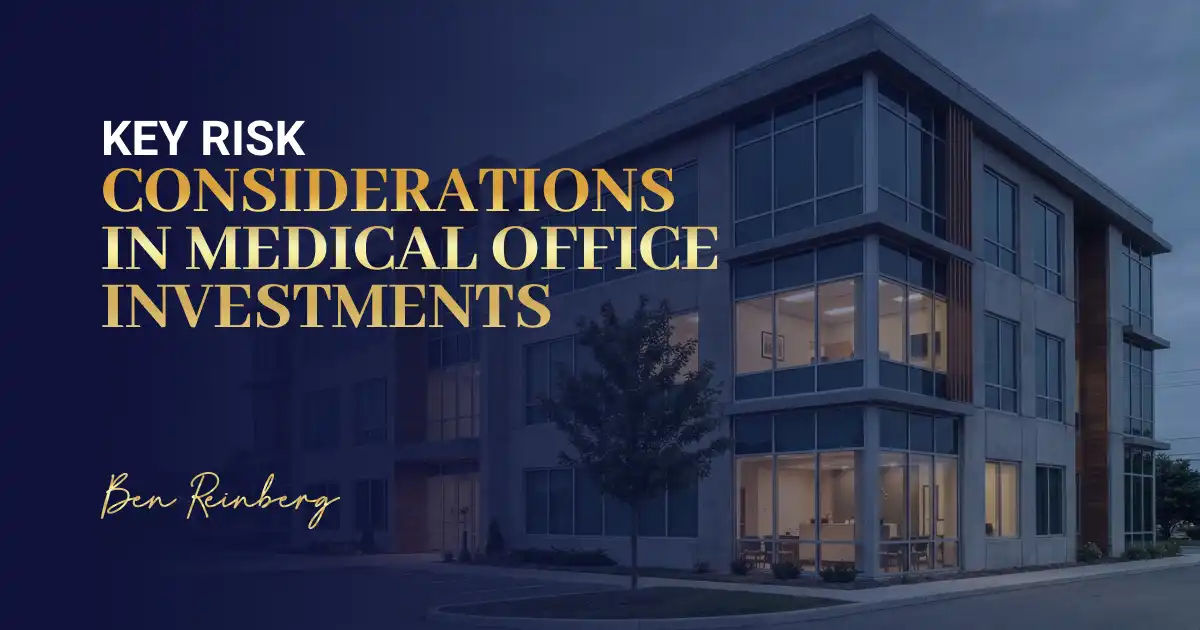
While MOBs are resilient, you still want to look closely at several risk factors so you can protect your cash flow and make confident, data-driven decisions:
When you evaluate these risks with a disciplined mindset, you get a clearer picture of how the asset will perform over time. The same kind of long-view analysis applies when you study long-term tax benefits such as CRE depreciation, something explored further in CRE. Understanding how those elements work together gives you stronger control over both your risk exposure and your long-term returns in medical office investing.
Medical office buildings are rapidly becoming a cornerstone for investors seeking dependable, cycle-resistant income. Anchored by essential-care demand, long-term clinical tenancy and purpose-built environments, MOBs offer a level of stability that few asset classes can match. The performance record at Ben Reinberg, including a $500M+ CRE portfolio and a 28% historical internal rate of return (IRR), demonstrates how disciplined underwriting, healthcare-driven site selection and specialized medical build-outs can turn consistent occupancy into lasting wealth.
Strengthening your portfolio with medical office assets enhances income reliability, improves risk distribution and supports sustained performance across shifting market conditions. These properties attract high-retention tenants whose operations depend on patient continuity, specialized equipment and long-duration leases, giving you a strategic edge in building durable cash flow.
Become an investor and align with a medical office strategy engineered for stability, essential-service demand and long-term growth.
A medical office building is a specialized real estate asset designed for clinical providers who need purpose-built environments for patient care, diagnostic services and treatment procedures. These medical office buildings support essential healthcare operations with features, such as medical-grade plumbing, enhanced electrical systems and optimized patient flow, making them among the most stable categories in MOB real estate. If you’re looking for dependable income, these properties offer long-term tenancy and consistent performance backed by essential-service demand.
Healthcare real estate includes properties used by medical practitioners, outpatient clinics, diagnostic centers and other outpatient care facilities. This sector focuses on buildings that deliver essential healthcare services, supported by long-term leases and high retention. For investors like you, healthcare real estate provides access to stable cash flow, low vacancy risk and tenants whose operations depend on continuity of care, making it a strategic foundation for long-term portfolio resilience.
To invest in medical office buildings effectively, partner with or study how a seasoned medical office building operator analyzes tenant strength, clinical demand, location within established medical corridors and the building's ability to support specialized healthcare operations. You’ll want to evaluate reimbursement risk, review historical occupancy and confirm that the infrastructure meets clinical standards. This type of medical office investment rewards disciplined underwriting and a long-term mindset, giving you exposure to essential-service tenants and stable cash flow backed by consistent patient demand.
In real estate, MOB stands for medical office building, a property type built specifically for healthcare providers and clinical specialists. MOBs differ from traditional office assets because they accommodate medical-grade infrastructure, treatment rooms, diagnostic equipment and regulated care standards. For investors, MOBs combine the strength of essential-service demand with the income stability that comes from long-term practice locations, making them a standout asset in today’s MOB real estate landscape.